According to LBT&C, irrational thinking/reasoning vivifies disharmonious mental-emotional states and habits, which culminate in the depletion of psychological energy and conduce to a sense of meaninglessness and futility about life.
The process of LBC involves six steps:
- reconstructing the reasoning at play in whatever problem you bring to the table
- identifying the fallacies in the reasoning
- refuting the fallacies through philosophical insight/analysis
- identifying the guiding virtue(s) that will counteract the specific fallacies
- discussing/finding philosophical perspectives that will support cultivating the guiding virtue(s)
- creating a plan to apply the philosophy in everyday life (a philosophical antidote)
This is easier to understand with an example:
Imagine that you habitually put the needs of others before and above your own to the point where it keeps depleting you and there is no real returning of the favors from those you come to the rescue of. You recognize you have a problem and want to stop this behavior but without sacrificing your humanity and suppressing your empathy and compassion. LBT&C can help you identify the underlying structure of this savior narrative, so that the irrational portions of it can be refuted reasonably.
So perhaps we discover that through all of this you tell yourself something like ‘without my help, these people won’t survive . . . I’m strong enough to help them and therefore I should.’ This causes great stress, and brings up feelings of guilt, shame, and anxiety.
The logical fallacies here are numerous and I won’t go into great detail since this is just an example but it should be easy to see that this summarily assumes that others are helpless, that their future is assuredly horrible without some more powerful intervention from beyond them, and that just because you can help you therefore should help. This deficient reasoning easily forgets that these people have so far survived without your help, that they do have some capability of surviving, that everyone encounters crisis and that crisis does not equate to doom/death, that in life there are many things you can do but it does not therefore follow that that means you should do them and so on, etc.
The core fallacies in your reasoning actually fall under specific categories, which will help us further understand them, refute them, and come up with antidotes. Once the fallacies are adequately exposed and refuted, then we can identify the guiding virtues that will counteract those fallacies. For example, perhaps the primary fallacy at play in our example (but also at play in most faulty reasoning) is called ‘demanding perfection’ and the guiding virtue that helps counteract it is called ‘metaphysical security.’ We need to engage in philosophical thinking that can help you to make peace with the inherent imperfection of life in a way that is truly convincing, thereby providing you metaphysical security so you don’t have to keep chasing ever elusive and non existent perfection. A religiously minded person might find it helpful to remember that only God is perfect, while life is messy and imperfect, unstable and so on. A non-religiously inclined person may instead find it helpful to think about the phenomenological idea that all light casts a shadow, and so anything that appears perfect is never without its shadows of imperfection, impermanence, and vulnerability.
Once sufficient philosophical thinking has been engaged, we are ready to construct an antidote and a plan to make use of it in the face of this particular habit you are addressing. So in our example this might mean that instead of saying and indulging this thought: ‘without my help, these people won’t survive . . . I’m strong enough to help them and therefore I should’ you actively replace it with ‘I am here to help those I love if they ask it of me, but hard times are a natural part of life.’ This remedy can be tweaked, refined, made shorter or added to depending on your needs. Only practicing with it in daily life can determine if it is helping or needs adjustment.
LBT&C sessions focus on dealing philosophically with specific mental-emotional and behavioral problems, and therefore end when those problems have been adequately addressed to the inquirer’s satisfaction. However, since there is no end to learning philosophy, when other specific problems, concerns, or inquiries regarding the mysteries of existence and your place in it arise for you down the road, it is always possible to go deeper.
Nota Bene
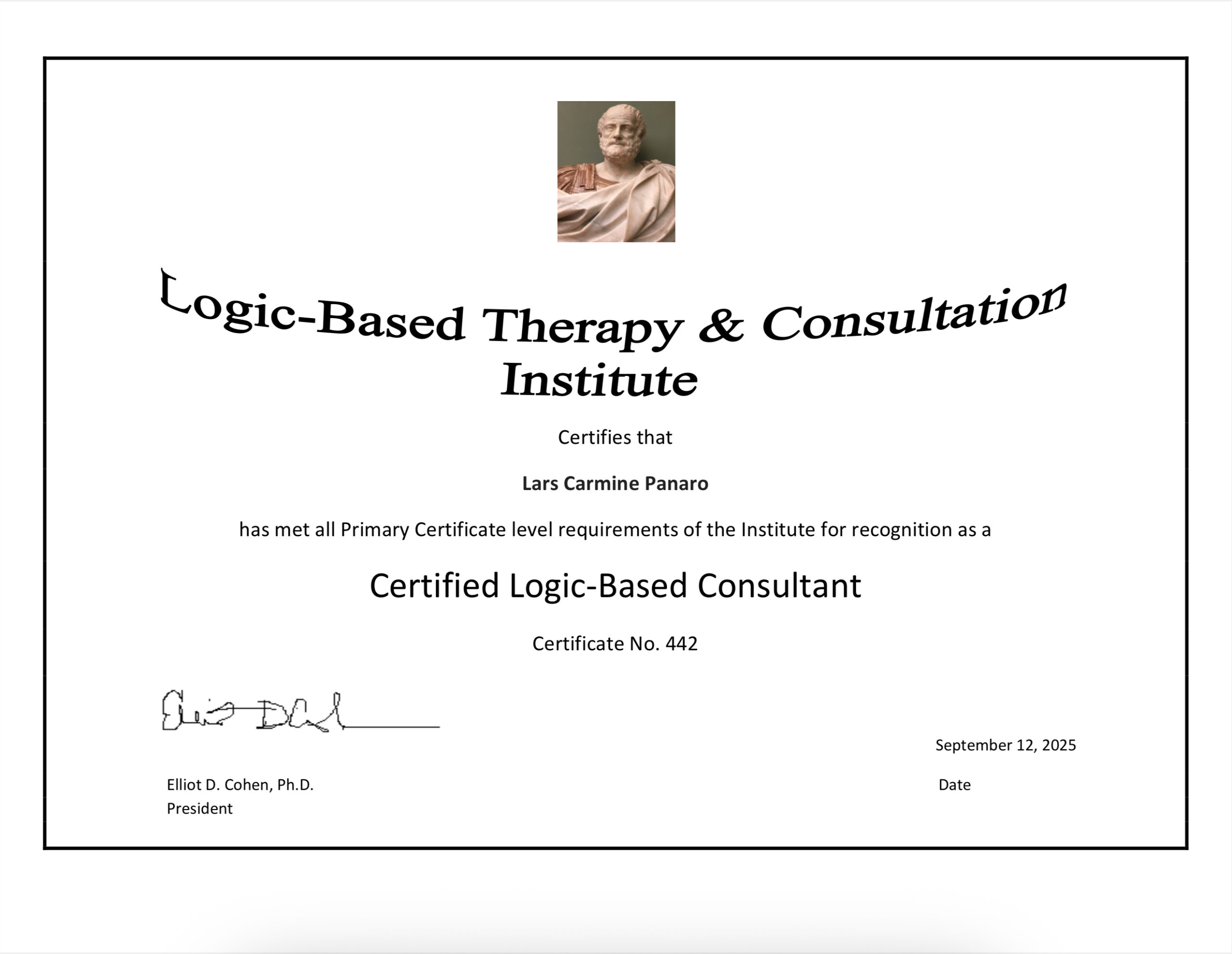
I am officially certified as a Logic-Based Consultant to practice LBT&C (Logic Based Therapy & Consulting) by the NPCA (National Philosophical Counseling Association). This means that I do not treat psychiatric disorders, nor does LBT&C or any other tools I make use of, constitute a viable replacement for psychiatric treatment by a licensed mental health practitioner. You can see the differences in practice areas here: https://npcassoc.org/practice-areas-boundaries/.
LBT&C addresses problems of living, not psychological disorders. While psychology looks for causal explanations for mental processes in previous events or the unconscious, philosophy examines the logical arguments that lie at the heart of mental-emotional-behavioral processes for their soundness.
The way I would put it is that every one of us encounters reality through narratives, and these narratives are always at play with regard to our inner life and how we interface with the world. So, whether one has a psychologically diagnosed/recognized mental disorder or not, we all deal with some amount of pain and suffering in the course of life.
LBT&C helps with navigating that intrinsic pain of life. It does not treat psychological disorders, which can be understood as a situation in which a person’s ability to deal with the intrinsic pain/suffering of life has gotten unmanageable for them on their own; where emotions like depression and anxiety have become debilitating and deeply interfere with one’s ability to function in day to day life.