‘Non ridere, non lugere, neque detestari, sed intelligere.’
“Not to laugh, not to lament, not to curse, but to understand.”
—Spinoza
(Quoted in The Denial of Death by Ernest Becker)

Photo by Lars Panaro
My Approach to Philosophy
Philosophy supports individual inquiry, growth, and ultimately creativity. It facilitates tuning into and cultivating narratives that speak to our hearts and bring us in touch with meaningful living. It also supports critical thinking, which serves as a tool for dealing effectively with thoughts and emotions which interfere with living meaningfully, creatively, and individually. Philosophy, as I practice it, is a form of what is called in India ‘Self inquiry’ (ātmavicāra), where the term Self (ātman) means both individual and universal Being; inquiring into one is automatically inquiring into the other, with the difference being the point of entry.
About the Name of the Website

Photo by Lars Panaro
Dia-noia is a Greek term meaning “thinking/understanding” (noia) “through” (dia). I chose it because I see what I do here (on and through this website) as thinking through the problems and questions of life to connect more deeply to ourselves and the meaningfulness at play in existence. Metaphorically put it’s ‘walking through (dia) the pathways of thinking’ (noia). I write the term with a dash (as dia-noia) to emphasize the idea that philosophical exploration and dialogue happen via relationship, and to differentiate my use of the term from its more specific meanings in the writings of various ancient Greek philosophers.
Philosophy and Psychology
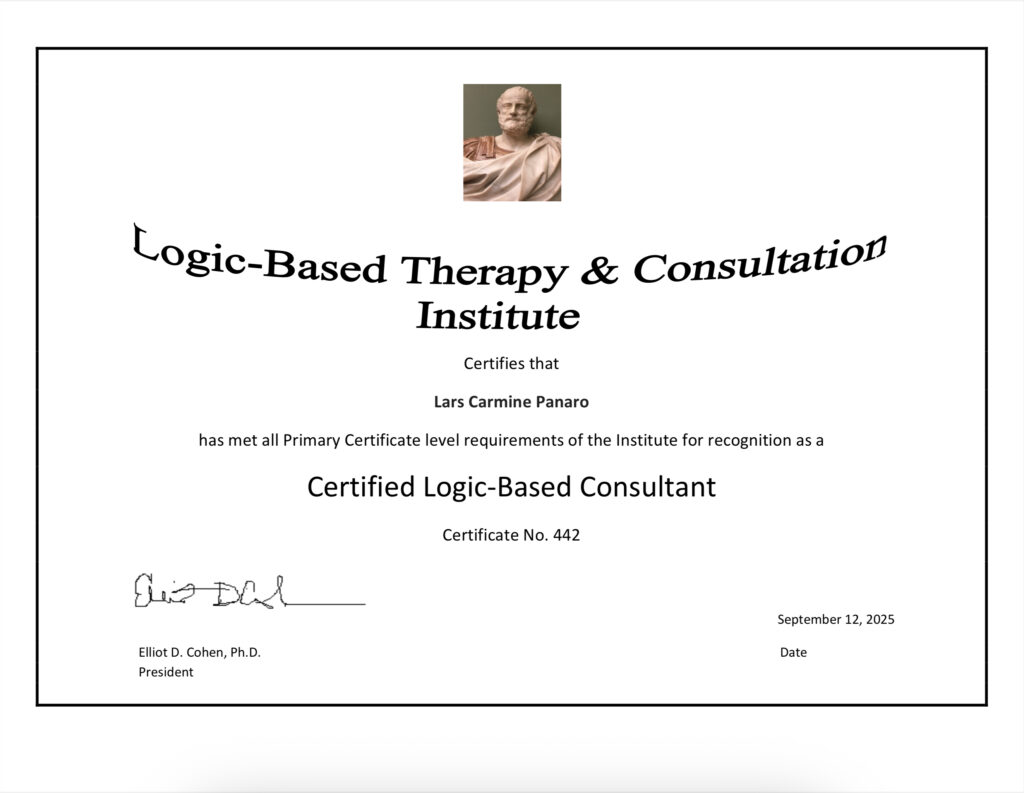
I am officially certified as a Philosophical Consultant to practice LBC (Logic Based Consulting) by the NPCA (National Philosophical Counseling Association). This means that I do not treat psychiatric disorders, nor is LBC or any other form of philosophical counseling that I offer, a replacement for psychiatric treatment by a licensed mental health practitioner. You can see the differences in practice areas here: https://npcassoc.org/practice-areas-boundaries/.
LBC addresses problems of living, not psychological disorders. While psychology looks for causal explanations for mental processes in previous events or the unconscious, philosophy examines the logical arguments that lie at the heart of mental-emotional-behavioral processes for their soundness. The way I would put it is that every one of us encounters reality through narratives, and these narratives are always at play with regard to our inner life and how we interface with the world. So, whether one has a psychologically diagnosed/recognized mental disorder or not, we all deal with some amount of pain and suffering in the course of life. LBC helps with navigating that intrinsic pain of life. It does not treat psychological disorders, which can be understood as a situation in which a person’s ability to deal with the intrinsic pain/suffering of life has gotten unmanageable for them on their own; where emotions like depression and anxiety have become debilitating and deeply interfere with one’s ability to function in day to day life.